Thursday, March 27, 2014

No Pain, No Gain

So you’re walking through the cafeteria and you bump into Luke and his tray, Luke was holding a bowl of steaming hot chili pepper soup. The bowl containing the chili tips over the side of the tray and is heading straight for your foot. Mind you, this is the day you chose to wear the cute new sandals you got at the mall last weekend. What’s the first thing that flashes through your head? I’m guessing it’s something along the lines of “OH MAN THIS IS REALLY GOING TO BURN”. But then the chili hits your foot and you feel…wait for it…ABSOLUTELY NOTHING. It’s not hot, it’s not cold, it’s just nothing, nothing at all.

You’re probably thinking, “how can this be? That can’t happen , you’re obviously going to feel pain when something scolding hot falls directly on your skin.” People with Congenital Insensitivity to Pain with Anhidrosis would have no reaction to the chili.  CIPA is a result of a mutation preventing certain nerve cells from being formed that are responsible for delivering signals of pain to the brain. This is a recessive disorder usually characterized by the inheritance of two copies of the mutated gene from each parent.
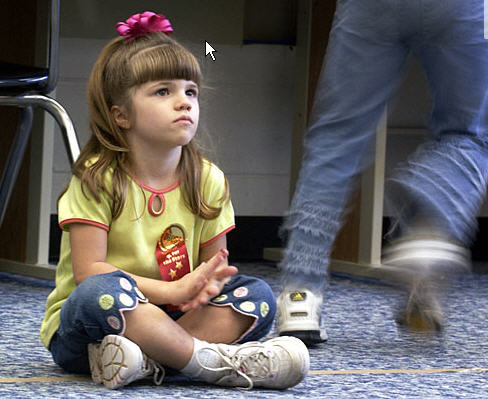

A little girl in Georgia named Ashyln is afftected by this disease. She senses absolutely no pain and as a result is in constant danger. At first glance, not being able to feel any type of pain whatsoever may seem like deliverance. However, Ashlyn had her cornea scratched at 8 months and didn’t not shed a tear over it. Her parents were not able to tell anything was wrong at all. Later, she went into her backyard and put her had on a hot pressure washer and just stared at the blisters.

When the pathway of nerves delivering pain sensation to the brain is disrupted, our livelihood itself is at risk.


Below is a clip from one of my favorite shows that illustrates a picture of a girl with CIPA.


https://www.youtube.com/watch?v=cmmrzOzX9I4

Thursday, March 20, 2014

The Memory Thief

If I were to ask you what you ate this morning for breakfast, or even what you ate last night or the morning before; you’d more than likely be able to tell me with no problem at all. Your recollection of facts of the past is at its peak at your young age. Now, if I were to ask someone from the ages of 65-80, his or her ability to provide me with that information would not be as strong as yours. This upward trend follows further into the lifespan of an individual. However, it’s totally different story when you can’t remember the girl’s name from biology that you met last month; then when you can’t remember the name of your first born daughter or who she is for that matter. People who experience the latter scenario are typically suffering from Alzheimer’s disease.


Alzheimer’s disease is the most common form of dementia and is characterized by extensive memory loss, problems in thinking, and a deviation from typical behavior.

Sitting in church one day in one of the chairs lined up against the back wall, I noticed the Castro (fake name-true story) family walk in through the back.  They came in with their 87 year old grandmother and right before they proceeded to go up the stairs to the balcony; the grandmother began to crouch down against a wall that had no chairs against it, as if an actual chair was there. When I asked my parents what was going on they told me about her Alzheimer’s. When I saw her crouch, I immediately thought of a concept I learned in my developmental psych class about how a young child has difficulty understanding object permanence and other aspects in that stage. This shows how when someone gets older, and unfortunately their brain starts to not be as sharp as it used to be, they sort of revert back to their childish ways.

In a late case of Alzheimer’s, the affected will become highly disoriented and have trouble focusing on being in the “now”.  Alzheimer’s gets worse over time and has no cure.

Having to watch a loved one go through this disease and its symptoms/ side effects can sometimes be harder than having the disease itself. You all have seen the Notebook right?


This video is an inside look at experiencing life with Alzheimer’s, please have your tissues nearby. This isn’t easy to see.

Tuesday, March 4, 2014

Let's Split it Up!

            It was the first day of sophomore year of high school and I was sitting in Mr. Ron’s (don’t worry that’s not his actual name) algebra class. Usually on the first day of class, teachers just introduce themselves; go over the syllabus and what is expected of the class and the materials you should bring.  After the usual speech, we were typically free to just do whatever we wanted for the rest of the class period. This introduction to the course however was much different than others, as Mr. Ron took the time out to tell us that he had epilepsy and what we needed to do if there was ever a time that he fell down and lost consciousness. He told us about his struggle with epilepsy and the tags he wore around his neck to let everyone know that he was seizure prone. I guess this was the first time that I had ever encountered someone with the condition and was able to find out more about it.
            Epilepsy is a disorder characterized by intensive recurring seizures.  This disorder is caused by a decrease in GABA, a neurotransmitter receptor, or damage done to it. Usually, medication can control the seizures and their outbursts, but there are times when surgery is necessary and many people affected by epilepsy may undergo a cutting of their corpus callosum in the brain.  The cutting allows the seizures to remain in one hemisphere of the brain and the seizures if any will only affect one side of the body. People who have this operation done are referred to as “split brain people”; and even though they go through such a drastic procedure they are still able to maintain their intellect, motivation, and ability to walk. Although, life still remains a daily challenge for them and their loved ones.

            The movie Rain Man, starring Dustin Hoffman, depicts the real life story of a man named Kim Peek. Peek was actually missing his corpus callosum and as a consequence of this particular misfortune, Peek was a well-known savant. He was able to simultaneously read both sides of an open book and provide traveling direction between any two cities of the world. He was known as the “living encyclopedia”.
             The short video to follow, tells of the amazing genius that is Kim Peek.